Personal system / 2026
The Long Game
Tracking becomes useful when it changes the next decision.
Why I built it
The Long Game grew from a large personal record of nutrition, training and progress data. The goal was not another dashboard; it was a system that could make a long-term process easier to understand and act on.
The product
Making the premise tangible.
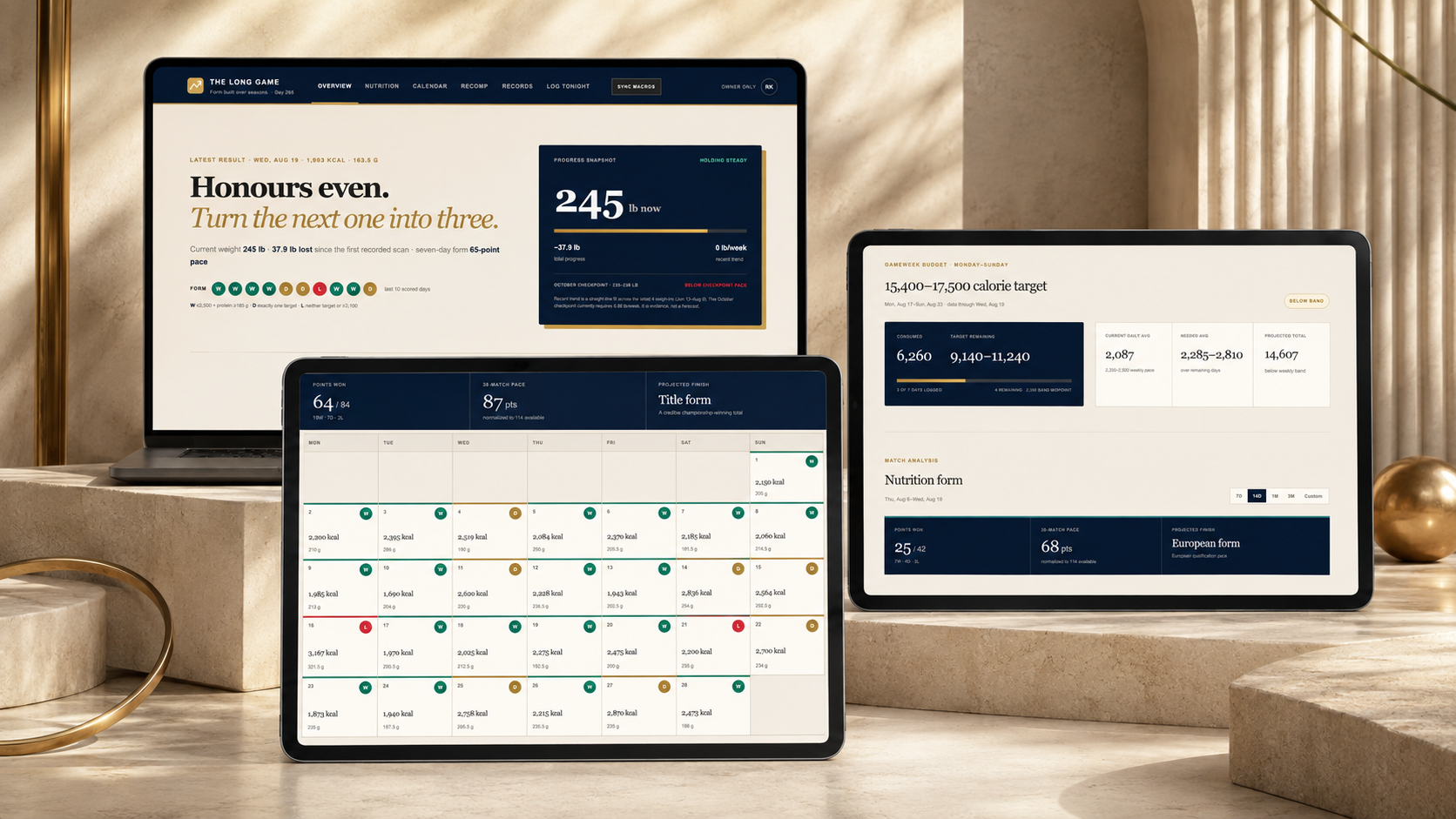
The private product turns daily nutrition, protein, hydration and training logs into a football-style form guide. Each day resolves as a Win, Draw, Loss or non-playing day. Wins earn three points, draws one and losses none; the current rate is then projected across a 38-match season and placed against familiar league-performance bands. Recent form, selectable time windows and the calendar explain how that pace was created—not just where it landed.
How it evolved
The thinking behind the build.
From a log to a decision system
The starting point was years of spreadsheet and scan history—not a blank product canvas. We first cleaned dates, units and malformed entries so the interface would be explaining reliable information rather than disguising messy inputs.
Turn consistency into form
We borrowed the W / D / L language of a football team’s form guide because it compresses a run of days into something immediately legible. The debate was how to preserve nuance: a day needed to reflect several behaviours, while sick days and genuine breaks needed to sit outside the competition as NP.
Make the 38-game pace meaningful
A daily result is useful; a season tells a story. Using three points for a win and one for a draw, the product projects the current rate across a 38-match league and maps it to recognisable performance bands. Seven-day, fourteen-day, monthly, three-month and custom windows show whether form is holding or merely spiking.
Let UAT rewrite the rules
Testing revealed places where the scoring hierarchy produced the wrong lesson, plus charts and controls that did not travel well to mobile. Those findings changed rule precedence, comparison views and the interface itself rather than being treated as cosmetic bugs.
Match the identity to the philosophy
Early red-and-black, target-driven framing made the product feel urgent and finite. Deep navy, gold and The Long Game better expressed the system we had actually built: private, patient and focused on the next run of form.
The product / In context
Key decisions
Where product judgement showed up.
- 01Use W / D / L as coaching language, never as a moral judgement
- 02Combine nutrition, protein and activity rules rather than let one number decide the day
- 03Separate daily form from the longer 38-game points pace
- 04Mark illness and genuine non-playing days as NP so they do not distort competitive form
- 05Keep the product owner-only and remove countdown-style pressure
My role / AI’s role
I defined the personal rules, ranges, language and decisions the system should support. AI assisted with data cleanup, interface design, implementation, analytics logic and iteration.
Iteration
The first build was the beginning.
Real historical data surfaced malformed dates, inconsistent units and scoring contradictions—including days where the same calorie result could look acceptable even when another important input had been missed. We revised precedence rules, tested rolling windows, improved graph and mobile readability, and removed countdown language that made the experience feel short-term. The product eventually moved from a red, goal-oriented identity to deep navy and gold—and from a working title to The Long Game—because consistency, not urgency, was the point.
What I learned
- A familiar metaphor can make complex progress easier to read without oversimplifying it.
- Scoring precedence is product logic: every edge case changes what the system teaches.
- Long-term pace is more useful than a countdown when consistency is the behaviour to reinforce.
- Privacy constraints can clarify what a public case study should actually explain.