Co-built browser game / 2026
Top Corner
A football game designed with my son—not merely made for him.
Why I built it
Top Corner began as a different kind of build. Instead of arriving with a finished concept, I made the product decisions with my son Omar. We worked through what the player should do, who they should play for, what should feel exciting and what should never get in the way.
The product
Making the premise tangible.
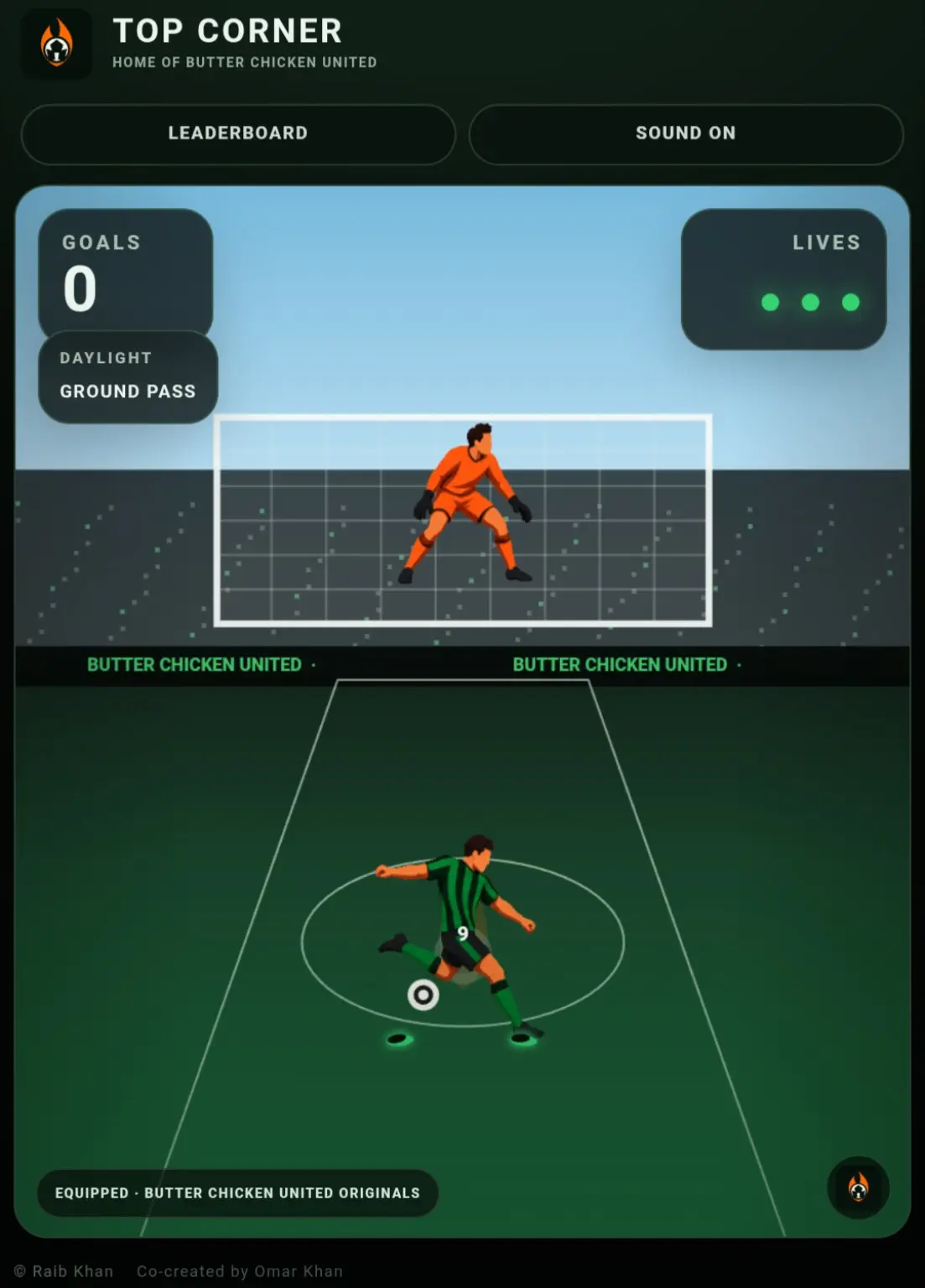
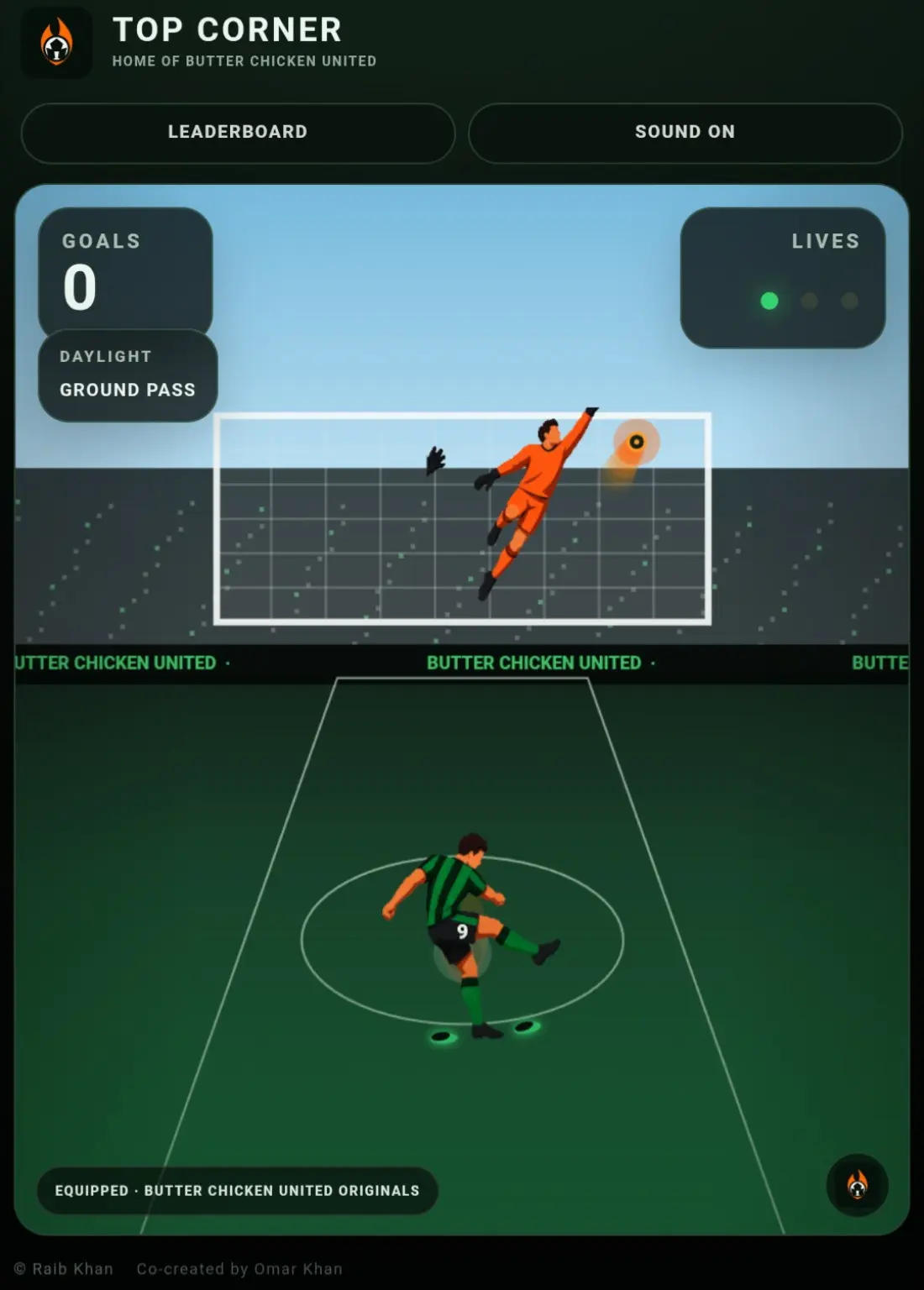
The result is a one-touch timing game: tap as the ball reaches the player and try to beat the goalkeeper. The interaction stays singular across touch, click and spacebar, while pass type, defenders, goalkeeper reactions and environmental conditions create variation. Three lives keep each run legible, quick restarts protect momentum, and rare exceptional finishes unlock brief boot-choice rewards.
How it evolved
The thinking behind the build.
Start by asking, not presenting
Omar was not handed a nearly finished game for approval. We made the foundational calls together: football, one-touch shooting, Butter Chicken United, progression, celebrations, rewards and the emotional tone of a successful finish.
Turn a simple action into a fair system
The early engine did not always make the relationship between input and outcome obvious. Pass speed, strike window, shot trajectory and goalkeeper response were tuned until the player could understand why a shot scored, missed or was saved.
Let play-testing rewrite the presentation
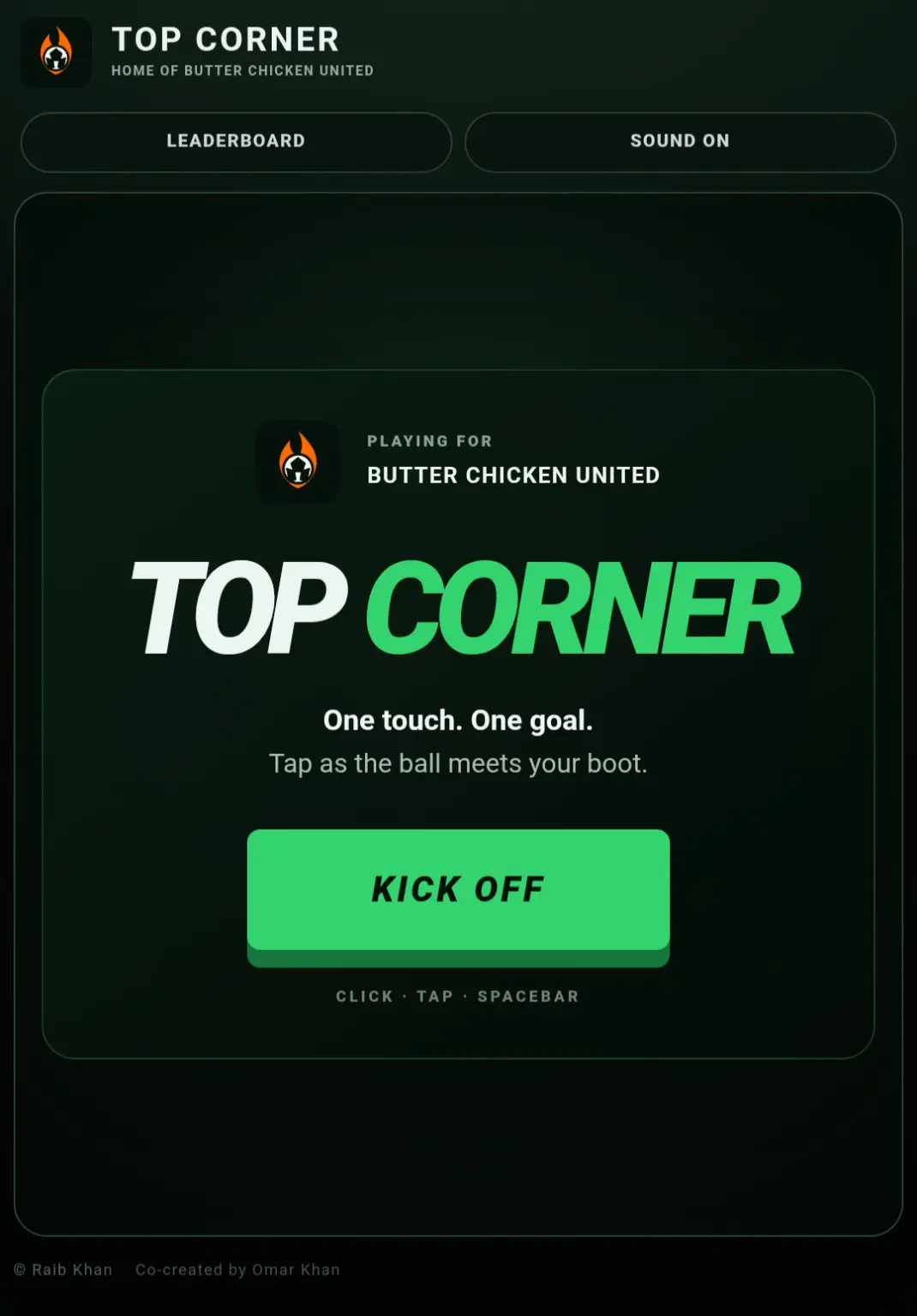
Realistic player art clashed with the field, the mobile goal felt oversized and the opening screen crowded the first decision. Those were not surface complaints; each one changed how approachable and coherent the game felt.
Reward the moments worth remembering
Perfect finishes and the rarer AMAZING TOP CORNER moment create peaks inside a short loop. Special boot choices became a small shared reward—expressive enough to delight without turning the game into an inventory system.
The product / In context
Key decisions
Where product judgement showed up.
- 01Keep the entire game centred on one timed touch
- 02Make early success possible but leave meaningful room for mastery
- 03Build the identity around Omar’s Butter Chicken United
- 04Use football-specific sound and crowd atmosphere without background music
- 05Make exceptional top-corner finishes rare enough to feel special
- 06Hold back the public playable link until the game earns a proper release
Co-building / Omar’s role
His decisions are in the product, not just the credits.
Omar chose Butter Chicken United, shaped the team world and progression, pushed for celebrations and special boots, and rejected background music in favour of the sounds of football. Our back-and-forth also exposed when the game felt unfair, visually inconsistent or too busy. The point was never to manufacture something on his behalf; it was to give his judgement consequences and build something neither of us would have arrived at alone.
My role / AI’s role
Omar and I owned the game. He shaped the club, team world, progression, celebrations, rewards and the decision to use football sounds without background music. I translated our choices into product rules, tuned the experience with him and held the quality bar. AI acted as our implementation partner across the game engine, interface, animation, audio and responsive behaviour.
Iteration
The first build was the beginning.
The first build established the shot mechanic, but play-testing quickly became the real design process. We adjusted pass speed, timing windows, goalkeeper reactions, defender frequency, life expectancy and difficulty progression. We also replaced realistic-looking player art that felt disconnected from the game’s visual world, reworked the mobile goal proportions and simplified an opening screen that was trying to explain too much at once.
What I learned
- Co-building works when the child’s choices genuinely change the product.
- A one-input game still needs a fair and understandable cause-and-effect loop.
- Character design, sound and motion must belong to the same world as the mechanic.
- Play-testing together turned abstract preferences into specific product decisions.