Learning product / 2026
True North Study
A study guide became a learning system when progress, practice and confidence had to agree.
Why I built it
True North Study was built for a real household need: turning the official Canadian citizenship material into a calmer, more structured way for Sana and me to learn, practise and understand whether we were actually ready.
The product
Making the premise tangible.
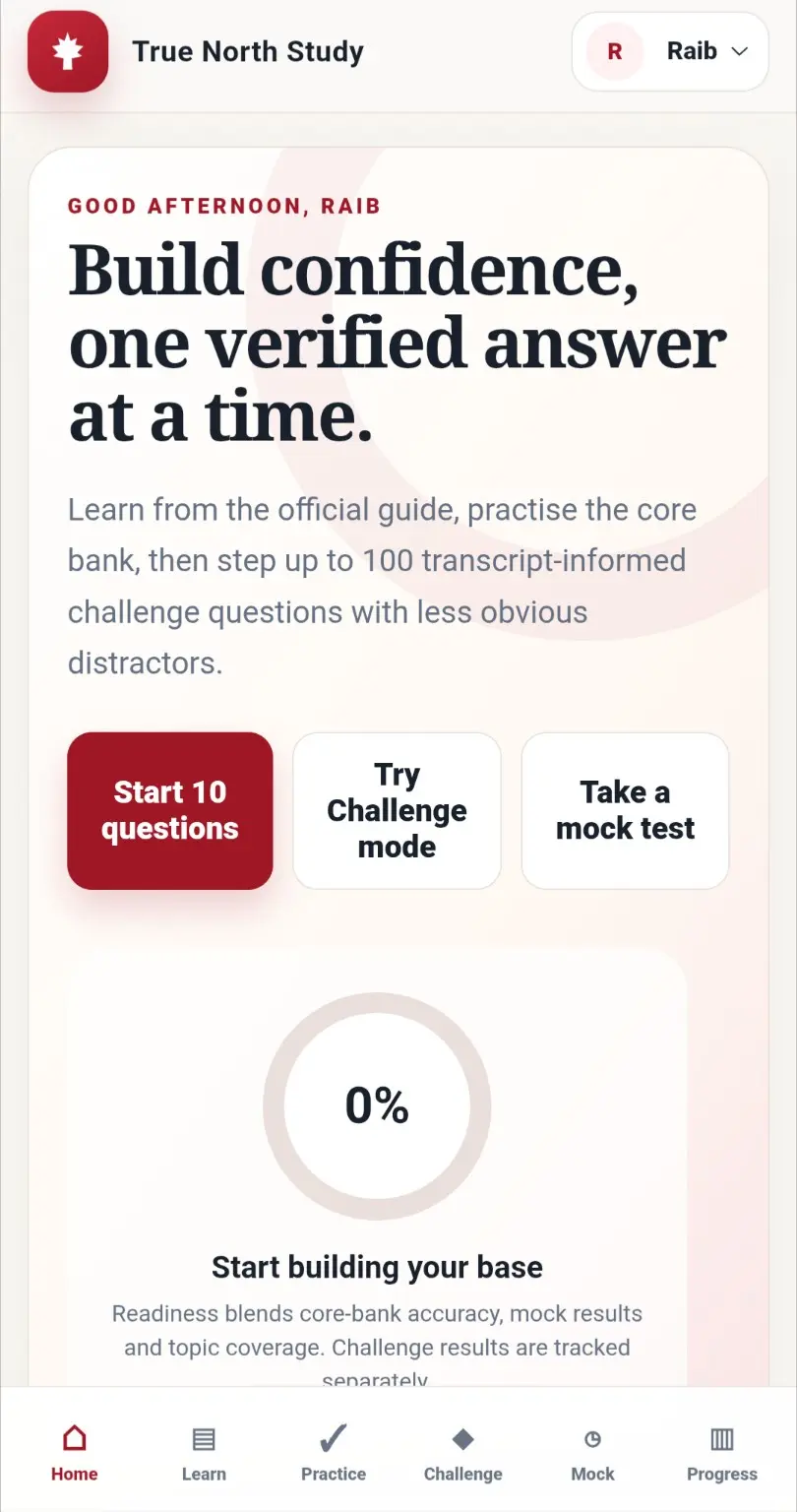
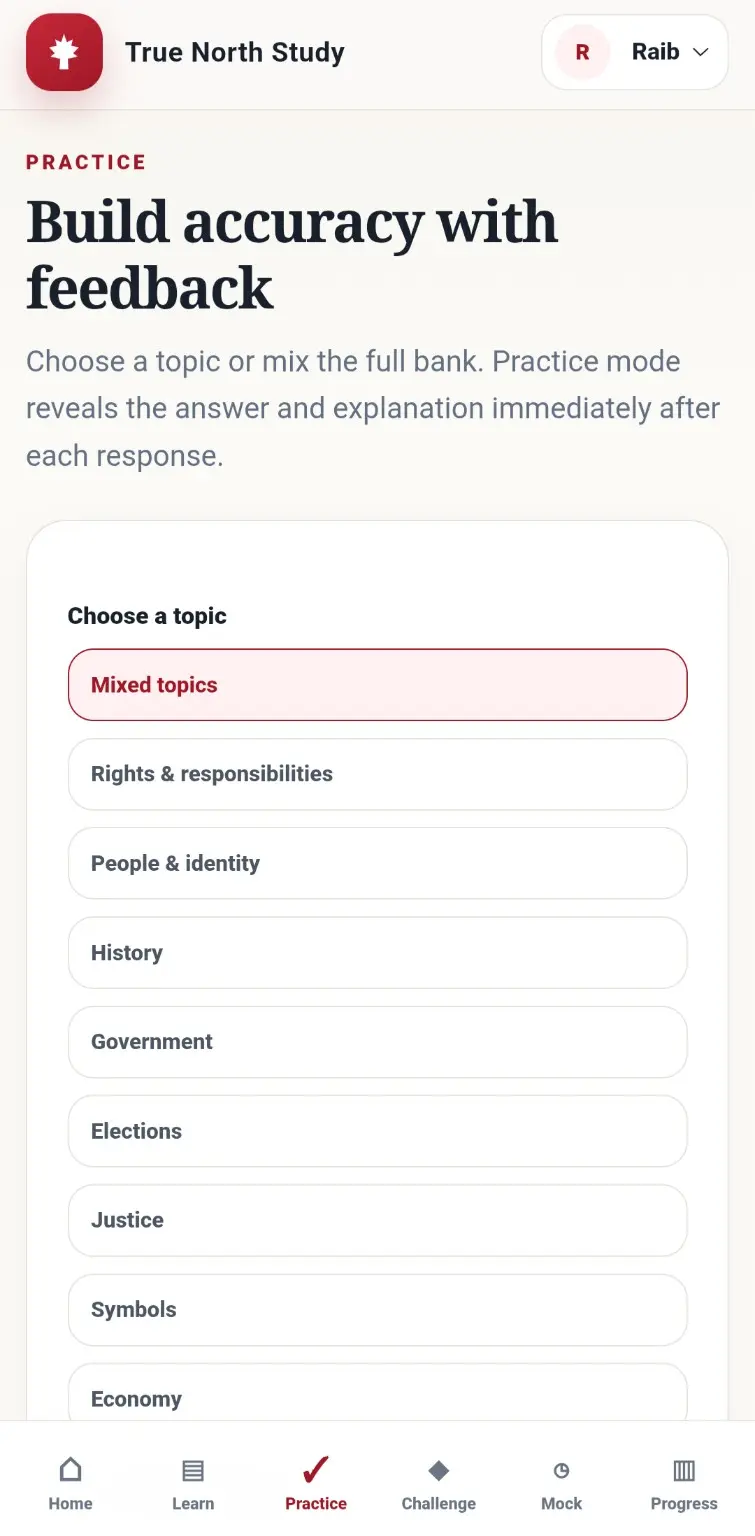
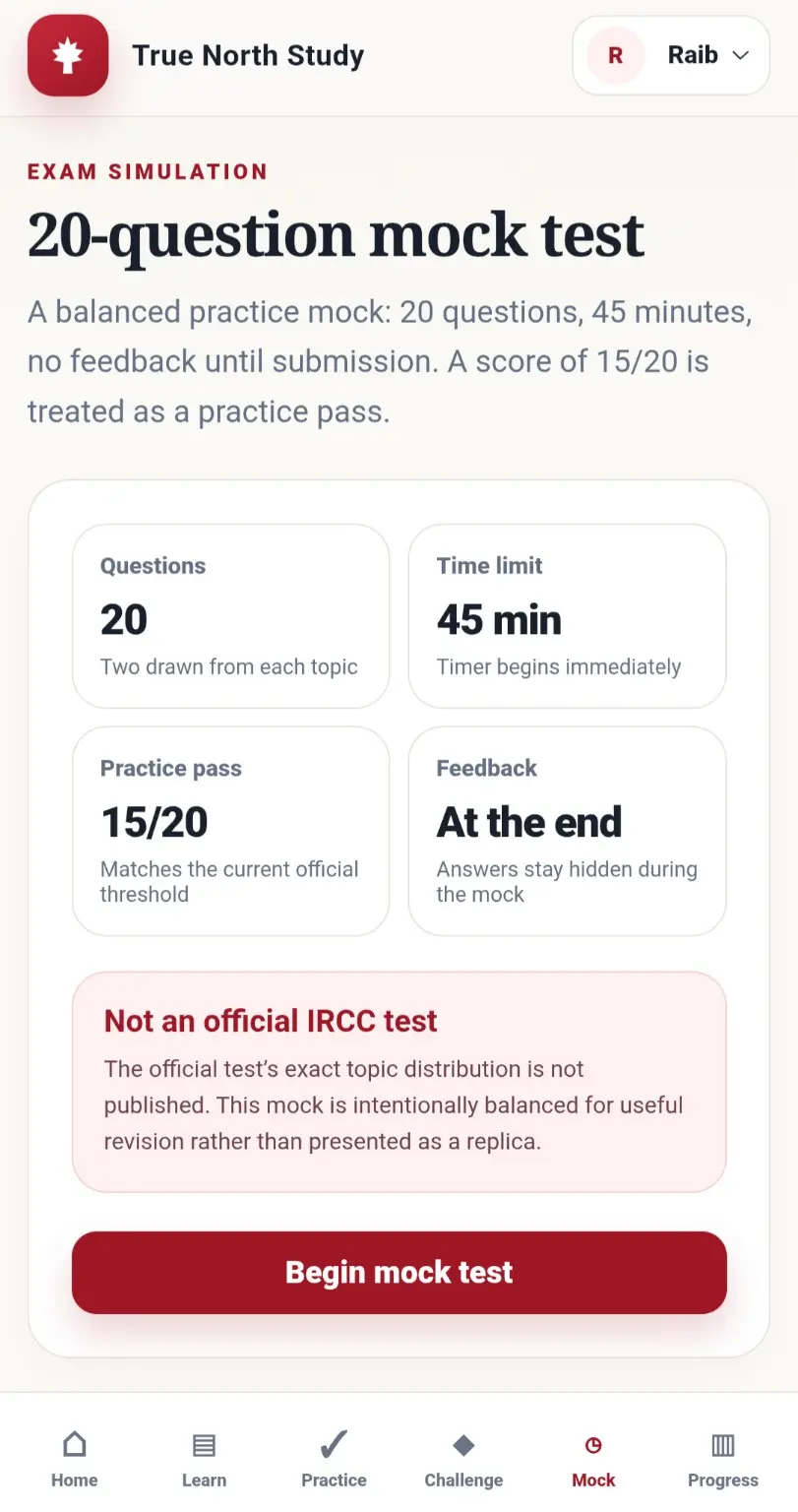
The private product organizes the official guide into ten topic lessons and pairs them with 100 independently written questions. Practice can be drawn by topic or mixed across the full bank, while a 20-question, 45-minute mock with a 15-out-of-20 practice threshold withholds feedback until submission. Mistakes, topic accuracy, mock history and a readiness indicator make progress visible without pretending the product is an official IRCC test.
How it evolved
The thinking behind the build.
Begin with the official material
The product did not replace Discover Canada. Ten structured topic lessons made the guide easier to navigate while preserving links back to the authoritative source.
Separate learning from assessment
Practice reveals the answer and explanation immediately; mock mode deliberately waits until the end. That distinction lets one mode teach while the other tests recall and decision-making under realistic pressure.
Make challenge questions genuinely useful
A second bank introduced less obvious distractors without drifting into trivia. The aim was to test understanding of the source material, not reward memorization of the first question set.
Define readiness without pretending certainty
Topic coverage, practice accuracy, mock results and the mistake bank contribute different signals. The interface combines them carefully while stating that its pass line and question balance are practice conventions—not official IRCC specifications.
The product / In context
Key decisions
Where product judgement showed up.
- 01Ground the lessons in Discover Canada and link back to official sources
- 02Keep practice feedback immediate but hide answers during timed mocks
- 03Use deterministic scoring rather than an AI opinion about readiness
- 04Separate core learning, challenge questions and full mock conditions
- 05Store progress locally for a private-first product without an account system
- 06Never present the mock as a replica of the official IRCC test
My role / AI’s role
I defined the learning structure, modes, scoring, source discipline, progress model and privacy boundary. AI assisted with organizing the material, drafting original practice questions, implementation and QA; every factual learning path was designed to remain grounded in the official guide and current Canada.ca sources.
Iteration
The first build was the beginning.
The product evolved from a collection of material into a study loop. Topic lessons created the base; practice added immediate explanation; challenge mode introduced less obvious distractors; mock mode tested recall under time and delayed feedback. Progress then had to reconcile coverage, accuracy, mistakes and mock performance instead of rewarding the simple act of clicking through pages.
What I learned
- Learning products need to distinguish exposure from understanding.
- A transparent readiness model is more useful than a motivational percentage with no logic behind it.
- Source discipline matters more when the product teaches facts with real consequences.
- Private-first architecture can be the right product decision, not a temporary limitation.